How to outsource your social media: what to expect, what to budget, and what to avoid

The job you didn't apply for
You started a skincare line. Or a wellness studio. Or a small label making beautifully cut linen. You did not sign up to become a full-time content producer. But here you are, filming a reel at 11pm and rewriting the same caption for the fourth time.
Most small business owners lose several hours a week to social media, realistically three to ten once you count planning, shooting, editing, and posting. That is a part-time hire's worth of hours, pulled straight out of the work only you can do: making the product, talking to customers, running the business.
At some point the maths stops working. That is usually when founders start thinking about handing it over. But "outsourcing social media" covers everything from a £275 content bundle to a £5,000 retainer, and the gap between a smart spend and an expensive mistake comes down to knowing what you are actually buying.
This is the full version: what outsourcing includes, what it costs, what good work looks like in the first ninety days, and the red flags that quietly drain budgets. It is long, so use the summary below to jump to what you need.
The short version
- Outsourcing splits into three jobs: strategy, content, and management. Work out which you need before you spend anything.
- Costs run from roughly £300 a month (very entry-level freelancer) to £5,000+ a month (large agency). Boutique studios sit in between.
- One hire can only be great at one or two things. A studio covers every angle: photo, video, copy, scheduling, and reporting, each done by someone who is actually good at it.
- Expect setup in month one, consistent output in month two, and real signal by month three. Anyone promising fast follower counts is selling the wrong numbers.
- Your team does not need to be local. For a digital product, a great remote studio beats a mediocre local one.
- Judge a partner on strategy and results, not post volume. For product brands, relevance beats reach.
What "outsourcing your social" actually means
It is not one thing. When founders say they want to outsource social media, they usually mean one of three jobs, and the price depends entirely on which. Most bad value comes from paying for one and assuming you are getting all three.
Strategy. The thinking. Who you are talking to, what you post and why, which platforms earn your effort, and how any of it connects to sales. Done properly once, it holds for six to twelve months. This is what stops content becoming a weekly guess.
Content. The actual output. Photography, video, graphics, and captions in your voice. This is where most of the time and cost sits, because doing it well is genuinely labour-intensive.
Management. The running of it. Scheduling, posting, replying to comments and DMs, community engagement, and reporting on what worked so the next month is sharper.
A strong arrangement covers all three as one system. You can buy them separately, but they lean on each other:
- Content without strategy looks nice and sells nothing.
- Strategy without content is a plan gathering dust in a Google Doc.
- Either one without management means it still lands back on your plate at 11pm.
If you have taste and time to shoot but no plan, you buy strategy. If you have a plan but no hours, you buy content and management. Knowing which of the three you need is the single biggest lever on whether outsourcing pays off.
The four ways to outsource, compared
There are really only four models. Each trades cost against how much of the work, and the thinking, you hand over.
Freelancer. One person, usually juggling several clients. Good for founders who need consistent posting and some design help, and who can still feed the process with product knowledge and raw footage. Flexible and personal. The risk is capacity, and range: one person is strong at one or two things, not all of them (more on that below).
Boutique studio. A small team with a defined point of view. You get strategy, content, and management under one roof, plus the spread of skills a single freelancer cannot cover alone: a designer, a strategist, a photographer, someone who actually understands your category. Best for founders who want it handled properly without paying for a large agency's overheads.
Full agency. Bigger teams, bigger retainers, bigger client rosters. Strong on process and formal reporting. The trade-off is that a small beauty or wellness brand can become a small account in a big room, handed to a junior while the senior people you met in the pitch move on to the next new logo.
DIY with template packs. Not outsourcing in the traditional sense, but worth naming. You buy the design system and post it yourself. Best for pre-revenue or very early brands where budget is tight but taste is not. You keep control and save money. You also keep the hours.
| Model | Best for | Typical cost | Main watch-out |
|---|---|---|---|
| Freelancer | Consistency and design, when you can still supply footage | Starting from £300 / month (£300 is very entry-level) | Limited capacity and range |
| Boutique studio | Strategy, content and management handled as one | Starting from £650 / month | Smaller team, so book ahead |
| Full agency | Scale, process and heavy reporting | Starting from £1,500 / month, up to £5,000+ | Becoming a small account in a big room |
| DIY template packs | Early or pre-revenue brands with taste, tight budget | Starting from £275 (one-off) | You still do all the posting |
These ranges are our own read of the market, based on what we see brands actually paying.
What it actually costs
Two numbers matter, and founders usually only look at one.
The first is the retainer. Entry-level freelancers start around £300 a month, but be clear-eyed about what £300 buys: light, basic posting on one platform. Often there is no strategy and no bespoke content, just posts built on free, widely available templates that plenty of other brands are using too. A boutique studio or mid-tier package, with real strategy, custom content, and multi-platform management, tends to sit around £650 to £1,500 a month. Full agencies with video, weekly output, and formal reporting start near £1,500 and climb past £5,000 for large agencies.
The second is the number nobody prices: your own time, or the cost of hiring in-house. A full-time social media manager in the UK earns around £34,000 to £37,000 (Indeed, 2025). Add employer National Insurance, pension, software, and holiday cover and the real cost of that hire is comfortably over £40,000 a year.
And here is the part that matters most about hiring one person: they will be good at one or two things, not all of them. Someone who shoots is rarely the same person who edits video, writes sharp copy, builds the strategy, schedules, and reports, all to a high standard. That person mostly does not exist, and anyone who claims to be all six is usually a red flag. This is exactly where a studio or small team earns its place: the photography, the words, the strategy, and the reporting are each handled by someone who is actually good at it. You are not buying more hours. You are buying range.
So when you compare quotes, do not compare the retainer to zero. Compare it to:
- Your own hours (six hours a week is roughly 24 hours a month of founder time you are not spending on the business).
- A £40k+ in-house salary, all-in, for a single generalist who can only cover part of the job well.
- The cost of content that looks cheap, because generic content does not sell and quietly wastes every pound behind it.
A real pricing example
For reference, here is how a small London studio structures its pricing. KURAE's Content Studio tiers cover content creation and posting only, no community engagement or email:
| Content Studio | Posts / week | Platforms | From (ex VAT) |
|---|---|---|---|
| Starter | 3 | 1 | £650 / month |
| Social Support | 5 | Up to 2 | £900 / month |
| Social Partner | 6-7 | Up to 3 | £1,450 / month |
If you also want community engagement and email handled, that is a Growth Support retainer, which layers ongoing engagement and email marketing on top of the content:
| Growth Support | What it adds on top of content | From (ex VAT) |
|---|---|---|
| Marketing Essentials | Monthly email newsletter + community engagement (3 days/week) | £1,250 / month |
| Growth Marketing | More content + email + engagement (4 days/week) + campaign support | £1,900 / month |
| Full-Scope Marketing | High-volume content + 2 emails/month + engagement (5 days/week) | £2,600 / month |
Everything is approved in Notion before it goes live, and management runs on a three-month minimum, which is not a lock-in tactic so much as an honest floor: consistency needs time to work. Full breakdown on the services and pricing page.
✧✧✧
☕ Case study: Private Coffee Collection
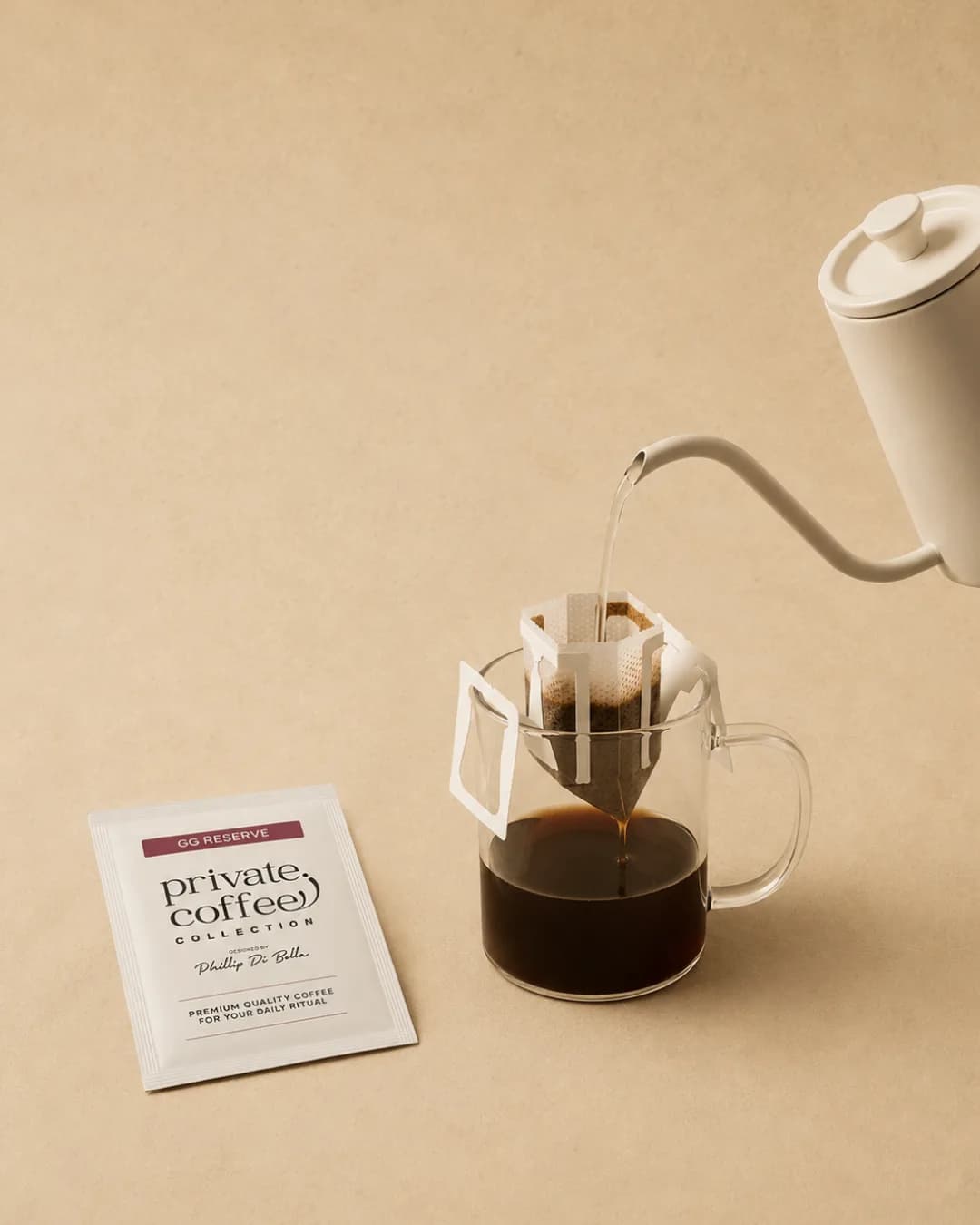
PCC is a premium direct-to-consumer roastery founded by Philip Di Bella, one of the most recognised names in Australian coffee. Strong credentials, no social presence to match. We built the strategy and content system from scratch and ran it at a steady five posts a week across Instagram and LinkedIn, focused entirely on organic content. The result was consistent, premium content that matched the brand, delivered by a London studio for an Australian one. Proof that a remote team can hold a high bar. Read the full case study →
Do they need to be in your country?
Short answer: no. We work with brands anywhere, across the UK, Europe, the US, and Australia, and for a digital or e-commerce brand, a great remote team beats a mediocre local one every time.
What actually matters is not a shared postcode. It is:
- Enough working-hours overlap for approvals and quick turnarounds. A few hours a day is plenty when the systems are right.
- Someone who understands your market and the audience you are selling to.
- Clear async systems. We run planning and approvals in Notion, so feedback never depends on being in the same room or time zone.
Local only really matters when the work is physical: on-site shoots, events, pop-ups. If your product lives online, so can your team. PCC is the proof, an Australian roastery whose social we built and ran remotely from London across a three-month engagement.
What to expect in the first ninety days
Good outsourcing has a shape. The timings below are rough guides, not promises, and plenty of projects take a little longer to hit their stride depending on scope, footage, and how fast feedback moves. If someone promises a flood of posts in week one, be suspicious. That is activity, not strategy.
| Timeframe | What a good partner is doing | What you should see |
|---|---|---|
| Weeks 1-4 (setup) | Learning your brand, audience and product; building strategy and the visual system | Fewer posts than usual, lots of questions, a documented plan |
| Weeks 5-8 (ramp) | Consistent on-brand content going out; tuning the voice from your feedback | A full calendar running; early lift in engagement |
| Weeks 9-12 (signal) | Refining based on real data | Better engagement from the right people, more saves and shares, profile visits, first enquiries |
| Month 4+ (compounding) | Doubling down on what works, cutting what doesn't | Growth that builds on itself and a clearer line to sales |
Month three is where you should start seeing signal, and signal is not the same as virality. It looks like better engagement from the right people, more saves and shares, cleaner profile visits, and early movement in DMs and enquiries.
This matters because trust is the real product. 78% of consumers say a brand's social presence affects whether they trust it, rising to 88% for Gen Z (Sprout Social, 2024). You are not buying posts. You are buying the reason someone believes you before they have tried you. And before people follow, they care about originality and how you interact, not how often you post (Sprout Social Index, 2025).
Green flags and red flags
Once you know the shape of good work, the warning signs get easy to spot. Use this when you read proposals.
| Green flags | Red flags |
|---|---|
| Strategy and audience thinking before any posting | A posting schedule with no strategy behind it |
| A team where each skill is covered by someone good at it | One person claiming to shoot, edit, write, schedule and report equally well |
| Reporting tied to saves, shares, profile visits, enquiries and sales | Reports full of impressions and reach and nothing else |
| Content that could only be yours | Stock-looking graphics or free templates that could belong to anyone |
| Month-to-month after a fair minimum | Twelve-month lock-in with no break clause |
| Honest timelines (signal by month three) | Guaranteed follower counts in 90 days |
A few of these deserve spelling out.
Follower guarantees. Anyone promising "+10,000 followers in 90 days" is selling bought or junk audiences. It looks good in a screenshot and does nothing for sales.
Vanity reporting. Reach is easy to inflate. Ask what a partner measures and how it connects to revenue. 56% of marketing leaders now say social drives revenue (Sprout Social, 2025), so the reporting should be able to point at it.
The one-person unicorn. If a single freelancer promises world-class photography, video editing, copywriting, strategy, and reporting all at once, be sceptical. Range like that comes from a team, not one calendar.
When a sprint beats a retainer
Not every outsourcing decision is a monthly retainer. Sometimes you need a focused push with a clear start and end: a launch, a pop-up, a rebrand, a month of content banked before a busy season. This is where one-off sprints earn their place. You get strategy and a block of finished content in a tight window, without committing to ongoing support before you are ready.
A sprint is the right call when:
- You have a fixed event or launch date to hit.
- You need momentum and assets fast, then a breather.
- You want to test working with a studio before a retainer.
- You can DIY the posting, but need the system and the content built properly first.
Urgent, fast-turnaround projects are possible, but they need the capacity of a studio or agency, with several people working in parallel. A single freelancer usually cannot flex to that. A well-run week around a launch or pop-up can outperform months of aimless posting.
How to hand it over well
Outsourcing is not "set and forget", especially early. The best results come when you stop being the person who makes every post and become the person who protects the brand.
Give your partner three things and everything downstream gets easier:
- Access to the product, so they actually understand what they are selling.
- Your point of view, the opinions and taste that make the brand yours, so the content sounds like you and not a template.
- Fast feedback in the first two months, because that is when the voice gets locked in.
Then step back. Heavy input for the first sixty days while the voice is set, then a lighter touch: approvals, feedback, and the occasional product update or idea. If a partner still needs constant hand-holding after month two, something is off. And if you have hired well, the whole point is that this stops being your 11pm job.
FAQ
How much should a small brand budget to start?
Most small beauty, wellness, fashion, and food brands land between £650 and £1,500 a month for a proper mix of strategy, content, and management. Below that you are usually buying posting help without the strategy, and around £300 a month you are at the very entry-level end. If budget is genuinely tight, a one-off sprint or a template pack plus your own hours is a more honest starting point than a cheap retainer that produces forgettable content.
Freelancer, studio, or agency?
A freelancer suits founders who can supply footage and product knowledge and mainly need consistency and design, as long as you accept that one person cannot be excellent at everything. A boutique studio suits founders who want the thinking, the content, and the posting handled together, by a small team that covers every skill. A full agency suits brands with the budget and volume to justify a large team and heavy reporting.
Does my team need to be local?
No, not for a digital or e-commerce brand. What matters is enough working-hours overlap for approvals, someone who understands your market, and clear async systems. We work with brands anywhere, across the UK, Europe, the US, and Australia. Local only really matters when the work is physical, like shoots and events.
How long until I see results?
Expect setup in month one, consistent output in month two, and early signal in month three. Real compounding growth takes six months or more. Anyone promising fast numbers is usually promising the wrong ones.
Is a three-month minimum normal?
Yes, for management. Consistency needs time to build, and so does learning what your audience responds to. A short minimum is reasonable. A twelve-month lock-in with no exit is not.
The bottom line
There is no single right way to outsource, and no one can make this call for you. It comes down to three questions: how much of the work you want off your plate, how much you can spend, and how much of your own time and taste you can still put in.
- If you want it fully handled and you value consistency, a studio or agency retainer is the move.
- If you have footage and just need help posting, a freelancer can work, with £300 a month being very entry-level, so set expectations accordingly.
- If you are pre-revenue but have taste, a template pack or a one-off sprint keeps you consistent without the retainer.
Whatever you choose, judge it on strategy and results rather than post volume, make sure the skills you need are actually covered, and give it three months before you decide it is not working. The decision is yours. The point is to make it on purpose, not by default at 11pm.
Ready to hand it over?
KURAE runs social media for founders who have taste but not time. Strategy, content, and management, handled by a small London studio that works with premium beauty, wellness, fashion, and food brands anywhere, from the UK and Europe to the US and Australia, and treats every one like a publication worth protecting. Clients have been featured in British Vogue, Selfridges, Cosmopolitan, and Marie Claire.
If you would rather be building your business than filming reels at 11pm, read the KURAE story, see the services and pricing, or start the questionnaire and we will shape a plan that actually feels like you.